
In-Studio vs. Remote Interview Production: Which Is Better for Coaches in 2026?
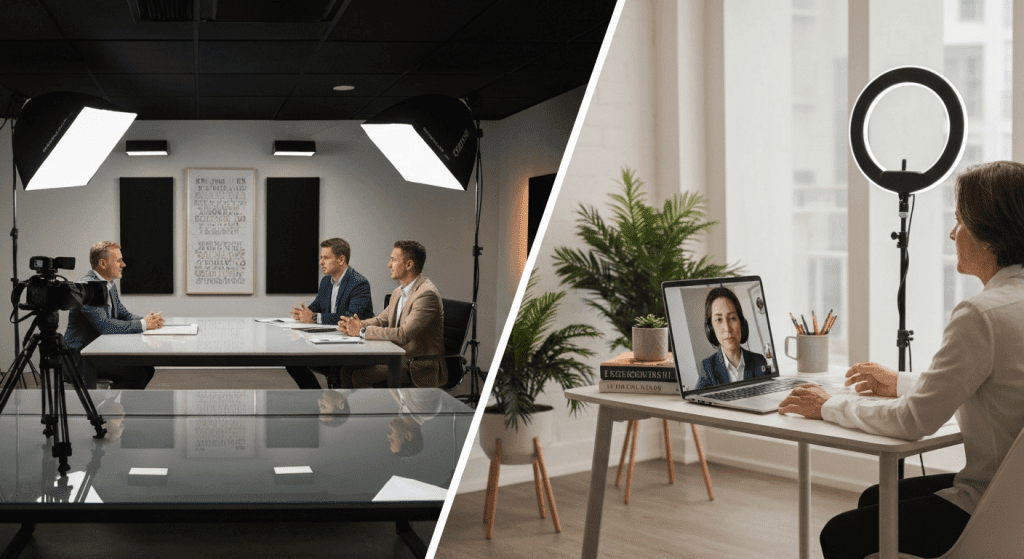
Table of Contents
- Why This Decision Matters More Than You Think
- What In-Studio Interview Production Actually Looks Like
- What Remote Interview Production Actually Looks Like
- Head-to-Head Comparison: In-Studio vs. Remote
- Which Format Is Right for You?
- The One Thing Both Formats Share
- FAQs
- Make Your Choice
You’ve decided you need a professional video interview. Good call. Now you’re looking at two options: record in a studio or record remotely from your home or office.
Both can produce something credible. But they’re not the same experience, and they don’t deliver the same result for every coach, consultant, or speaker.
This article breaks down what each format actually produces, where each one falls short, and how to figure out which is the better fit for where you are right now.
Why This Decision Matters More Than You Think
Most coaches and consultants lose deals before a sales call ever happens. A prospect visits your website, checks your LinkedIn, maybe reads your proposal — and then goes quiet. Not because your experience isn’t real. Because it isn’t visible.
A professionally produced media interview changes that. It shows credibility instead of claiming it. But the format you choose — in-studio or remote — affects how that credibility lands.
This isn’t a minor production detail. It’s a positioning decision.
What In-Studio Interview Production Actually Looks Like
An in-studio interview puts you in a professionally designed environment built for this kind of content. The lighting is controlled. The backdrop is intentional. Camera angles, audio, and overall visual quality are all dialed in before you sit down.
The result looks like something you’d see on a business news segment or a high-end podcast. That visual quality signals something before you’ve said a word: this person is taken seriously.
Where In-Studio Shines
- Visual authority at the highest level. The production quality is immediately apparent. For coaches and speakers targeting enterprise clients or premium engagements, that first impression carries real weight.
- No home environment variables. No worrying about your background, your lighting, your internet connection, or the neighbor’s leaf blower.
- A clear visual gap. If you want to stand out from every other consultant sending a Loom video or a self-recorded LinkedIn clip, the studio format makes that gap obvious.
Where In-Studio Has Limits
You have to travel to the studio. For coaches based far from a production location, that adds time and logistics. It’s a real consideration — just not necessarily a dealbreaker.
What Remote Interview Production Actually Looks Like
A remote interview is recorded from your own space — home office, dedicated workspace, wherever you operate. The key difference from a DIY video is that it’s still professionally produced. There’s a process, a format, and editorial guidance shaping how the final asset looks and sounds.
Done well, a remote interview looks clean, professional, and credible. Done poorly — which is what happens with most self-recorded video — it looks exactly like what it is: someone pointing a laptop camera at themselves.
That distinction matters. A well-produced remote interview is a completely different product from a Zoom recording or a selfie-style clip.
Where Remote Shines
- No travel required. You record from wherever you are. For consultants and speakers with packed schedules, that removes a real barrier.
- More accessible entry point. At $1,795 vs. $2,295, remote is the lower-cost path to getting a finished, professional video asset in front of prospects.
- Still builds genuine credibility. A properly produced remote interview positions you as an expert. It’s not a compromise — it’s a different format with its own strengths.
Where Remote Has Limits
The ceiling on visual quality is lower than in-studio. You can’t fully replicate a controlled professional set. If your home office has inconsistent lighting, a cluttered background, or poor acoustics, those factors affect the final product — even with strong post-production.
Head-to-Head Comparison: In-Studio vs. Remote
| Factor | In-Studio | Remote |
|---|---|---|
| Visual quality ceiling | Highest | High |
| Travel required | Yes | No |
| Price | $2,295 | $1,795 |
| Best for | Premium positioning, enterprise clients | Busy schedules, strong home setup |
| Credibility signal | Elevated | Strong |
| Environmental control | Full | Partial |
| Production turnkey | Yes | Yes |
| Time to deploy | Schedule, record, share | Schedule, record, share |
Both options follow the same three-step process: schedule your interview, record it, share the finished asset across your website, LinkedIn, and proposals.
Which Format Is Right for You?
Here’s a direct way to think about it.
Choose in-studio if:
- You’re targeting enterprise clients, large organizations, or high-ticket engagements where visual authority matters most
- You want the highest possible production quality with no compromises
- You’re positioning yourself at the top of your market and want your video to reflect that
- You can travel to the studio without it being a significant disruption
Choose remote if:
- Your schedule is packed and travel adds friction you’d rather skip
- You have a clean, professional home office environment
- You want a finished, credible video asset deployed quickly
- You’re starting with the $1,795 option and plan to upgrade later
Worth saying plainly: the remote option is not the budget version of a real interview. It’s a different format. For many coaches and consultants, it produces exactly the asset they need to start closing more clients.
A Note on Your Existing Setup
If you’re leaning toward remote, do an honest audit of your space. Good natural light or a quality ring light, a clean background, and a quiet room go a long way. Poor environmental conditions will limit what even strong post-production can fix.
If you’re genuinely unsure whether your space is up to it, that’s a reasonable signal to consider the in-studio option instead.
The One Thing Both Formats Share
The format affects the visual experience. It doesn’t change the core purpose.
Both options produce a media-style interview that positions you as a credible expert before your first sales conversation. Both give you a finished video asset to place on your website, your LinkedIn profile, and inside your proposals. Both are built to do the same job: make your expertise visible so prospects trust you before they ever speak with you.
People trust what feels earned, not promoted. A professionally produced interview — in-studio or remote — creates that feeling. A self-recorded video, a generic testimonial, or a DIY clip from Loom or BombBomb does not.
That’s the real comparison worth making.
You can see examples of both formats and learn more about the full process at obviouschoiceinterview.com.
FAQs
Is the remote interview lower quality than in-studio?
Not in terms of the production process or positioning strategy — those are identical. The in-studio option has a higher ceiling for visual quality because the environment is fully controlled. But a well-produced remote interview is still a professional, credible asset that outperforms any DIY or self-recorded video by a wide margin.
What equipment do I need for a remote interview?
The production team walks you through exactly what’s needed. Generally: a clean background, decent lighting, a quiet space, and a reliable internet connection. You don’t need to own professional camera equipment.
How long does the finished interview run?
Length varies based on your content and goals. The focus is on producing a complete, usable asset — not hitting a specific runtime. The finished video is designed to hold a prospect’s attention and communicate your authority clearly.
Can I use the finished video in more than one place?
Yes. The video is yours to deploy wherever it adds value — your website homepage, LinkedIn profile, proposals, email outreach, or anywhere else you’re building credibility with prospects.
How quickly can I get scheduled?
Both options have limited spots available each month. Once you apply, the scheduling process moves quickly. The sooner you apply, the sooner you have a finished asset working for you.
What makes this different from recording a video myself?
Editorial credibility. A self-recorded video looks self-recorded. A media-style interview — with professional production, a structured format, and intentional framing — looks like something that was earned. That distinction changes how prospects perceive you before they’ve exchanged a single word with you.
Is one format better for LinkedIn specifically?
Both produce video that works well on LinkedIn. The in-studio version tends to have stronger visual impact in a feed where most content is self-recorded or low-production. That said, a well-produced remote interview still stands out significantly compared to what most coaches and consultants are posting.
Make Your Choice
Your expertise is real. The question is whether it’s visible.
Pick the format that fits your situation — in-studio for maximum visual authority, remote for flexibility without sacrificing credibility — and get a finished asset deployed where your prospects are actually looking.
Visit obviouschoiceinterview.com to see real examples of both formats and apply for your interview.